

Tadashi Ebihara
Associate Professor, Ph.D. in Engineering
Faculty of Engineering, Information and Systems, University of Tsukuba, Japan
Digital communications and signal processing — with a particular focus on making acoustic links work in shallow water, where the channel is at its most hostile.
E-mail: ebihara <at mark> iit.tsukuba.ac.jp
Profile
Tadashi Ebihara received his B.Eng., M.Eng. and Ph.D. degrees in engineering from the University of Tsukuba, Japan. His doctoral thesis was on the design of acoustic communication systems.
His research is in digital communications and signal processing, and centres on the design and performance analysis of communication systems — above all, underwater acoustic communication. The shallow-water acoustic channel is a compelling problem precisely because it is so difficult: inter-symbol interference and Doppler spread can be several orders of magnitude greater than anything encountered in radio communication. He is also interested in acoustic communication for consumer electronics, where the challenge is the opposite one — making a modem light enough to run on an ordinary smartphone.
Work from the laboratory is published regularly in international journals and presented at international conferences; the full list is on the Publications page.
Research
Underwater acoustic communication systems (2010–)

Underwater acoustic communication in shallow water underpins a wide range of activities — navigation and control of autonomous underwater vehicles among them — and the demand for higher data rates keeps growing. It remains an open problem. The shallow-water channel suffers severe multipath propagation, varies from moment to moment, and offers very little bandwidth. On top of that, the platform carrying the modem is usually constrained in both physical space and battery power. A link has to be fast, reliable and power-efficient under all of those constraints at once.

Current work is on signal processing designed to meet those requirements — orthogonal signal division multiplexing (OSDM), orthogonal frequency division multiplexing (OFDM), and single-carrier modulation with adaptive equalisation. Network protocols are a related interest, since underwater networks will matter for resource exploration and coastal security.

Methods have to be measured, not just simulated. Basic trials are run in a test tank with a wave-making device, thanks to the cooperation of the Center for Research in Isotopes and Environmental Dynamics at the University of Tsukuba; full trials are then carried out in the coastal waters of Suruga Bay.
Supported by the Japan Society for the Promotion of Science (FY2010–2011, FY2012–2013, FY2015–2018, FY2019–2022, FY2023–2026) and by the Murata Science Foundation Overseas Dispatch Program.
Acoustic communication for mobile devices (2011–)

As the computational capacity of mobile devices has grown, acoustic communication aimed at them has drawn increasing attention. It needs nothing more than a loudspeaker and a microphone — hardware that almost every mobile device already has.
The modem can be installed as software, but the number of operations required is substantial, and mobile processors — improving though they are — still struggle with it. Current work is on a software modem whose computational cost is small enough to suit these devices.
Visible light communication for intelligent transport systems (2014–)

Visible light communication is one of the enabling technologies for intelligent transport systems. Because existing LED lighting can serve as the transmitter, large-scale systems can be built on infrastructure that is already in place — traffic signals and vehicle tail lamps among them. The obstacle has been the receiver, which has typically required complicated and expensive hardware such as a high-frame-rate image sensor. Current work is on an optical attachment that allows an ordinary smartphone to act as a high-speed receiver instead.
Supported by the Japan Society for the Promotion of Science (FY2018–2020).
Acoustic monitoring for smart agriculture and livestock farming
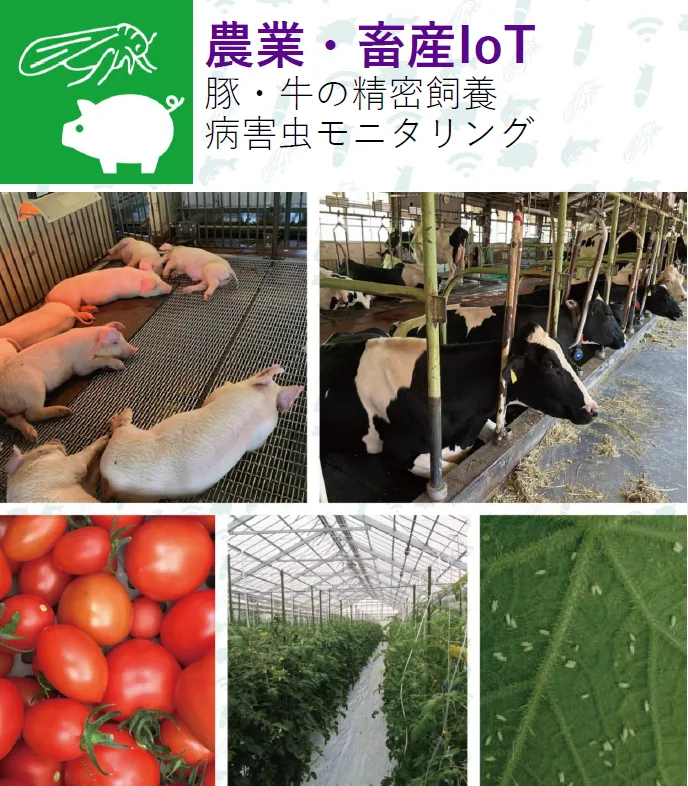
The same signal processing that recovers a message from a noisy channel can pick a meaningful signal out of the noise of a working farm. Detecting the early signs of illness in the sound of a pig sneezing, monitoring cattle, and finding whiteflies — a notoriously hard pest to control — inside a greenhouse are all problems of this kind. This work is carried out in real pig farms, cattle barns and greenhouses.
Positioning and information technology for underwater construction
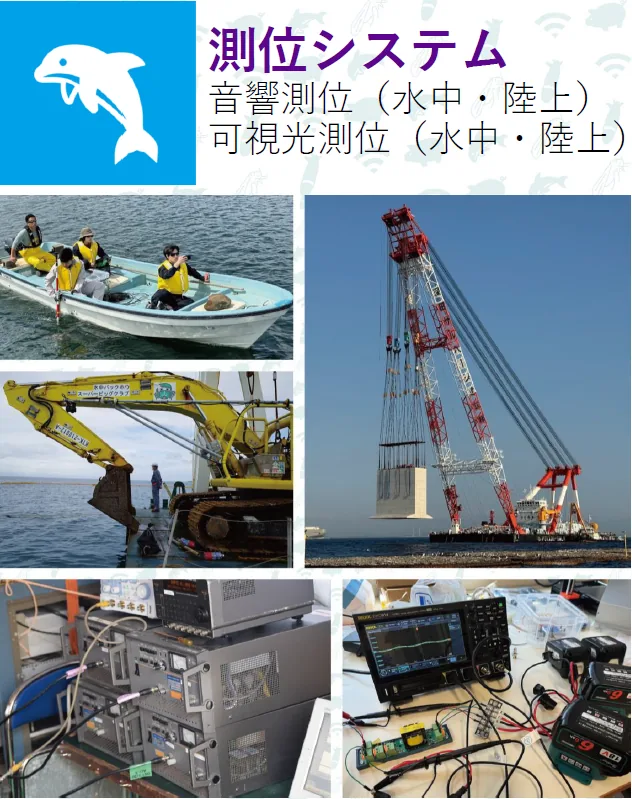
In turbid water an operator cannot see where the machinery is, and work proceeds slowly and cautiously as a result. Accurate acoustic and optical positioning changes that: it shortens construction schedules and makes underwater work safer. This is where the laboratory’s communication and positioning research meets civil engineering practice.
Career
- Apr. 2016 –
Associate Professor, Faculty of Engineering, Information and Systems, University of Tsukuba - Sep. 2013 – Dec. 2013
Visiting Professor, Circuits and Systems Group, Delft University of Technology, the Netherlands — collaborating with Prof. Geert Leus - Apr. 2010 – Mar. 2016
Assistant Professor, Faculty of Engineering, Information and Systems, University of Tsukuba
Professional memberships
IEEE · Acoustical Society of America · Marine Acoustical Society of Japan · Acoustical Society of Japan · Institute of Electronics, Information and Communication Engineers · Society of Agricultural Structures, Japan
Teaching
Undergraduate — College of Engineering Systems
- Communication Engineering (2015–)
- Applied Laboratory of Intelligent Interactive Systems (2010–)
- Applied Laboratory of Intelligent System Technologies (2010–)
- OS and Network (2014–2018)
- Engineering Systems for Human Life (2012–2018)
- Measurement Engineering (2012–2014)
- Introduction to Engineering Systems I (2010, 2011)
Graduate — Master’s and Doctoral Programs in Intelligent and Mechanical Interaction Systems
- Digital Communication (2011–)
- Fundamentals of Intelligent Interactive Technologies (2013–)
- Seminar in Intelligent Interaction Technologies V (2010–)
- Seminar in Intelligent Interaction Technologies VI (2010–)
Graduate — Ph.D. Program in Empowerment Informatics
- Smart Human Sensing (2015–)
Get in touch
If any of this interests you — as a prospective student, as a collaborator, or simply out of curiosity — please write. Enquiries are welcome even before you have decided anything.
E-mail: ebihara <at mark> iit.tsukuba.ac.jp